

Walking with Mr Kodzo
Martin Egblewogbe
I like small cars. Not least because I drive one, but surely, it cannot be denied that a sturdy, compact and cosy hatchback with great fuel economy is a good thing. Just about a year old, my sleek car handled smoothly as I sped along the brilliantly lit city streets. Lights poured in through the windscreen and the windows, sparkling whites from office blocks, yellows from the sodium street lamps, the red, amber, and green from the multitude of traffic lights signalling my progress along the boulevard, moving swiftly in concert with the other motorists, the bright headlights and the glow of taillights flowing into my cabin.
A clean, cool, fresh breeze whisked through the windows — there had been a downpour in the afternoon. I was at ease, content, happy.
I was already half an hour late for a get-together which was taking place at the Phoenix Hotel. This was by choice: I really did not see the need to be on time for the event, which was an “Old Boys’ ” re-union — one of those year group things held to remember the alma mater. It also gave past students of the school an opportunity to fraternize, and to raise funds for some projects in the school. The invitation card promised a pleasant evening of entertainment with a live band, and dinner. There was a line that claimed that it would be “a special night…”
The Phoenix was approached by a sweeping driveway that curled around a resplendent fountain, the gushing jet decorated with refractions of blue, red and green lights. At the entrance a valet took charge of my car, and I was met at the entrance by a smiling doorman and a concierge who showed me to the restaurant.
The gleaming glass doors rolled open silently and I stepped, to my surprise, into a room almost empty. Apart from the bartender at the bar to the far left, dwarfed as he was by the towering shelves of booze, I could only see one other person. He was seated at a table in the middle of the room, hunched over a tumbler. A waiter appeared at my side and assured me that this was indeed the venue for the event, and no, no one else had arrived besides the other man — indicated with a nod in his direction.
I went over to the other guest. It was Mr Kodzo, our class master in our final year at the school. My memories of him were not great, but they were not unpleasant either.
He chuckled drily at seeing me, and we exchanged greetings. I would have preferred to sit elsewhere, but courtesy demanded I sat beside him. There were just the two of us there, after all. I cursed the legendary Ghanaian aptitude for lateness, and then thought I should have come in even later.
Having declined water from the bottle on the table, I ordered a drink at Mr Kodzo’s behest, and then we sat there, not quite speaking. Cool air wafted downwards from the air conditioning vent in the ceiling right above us. After a while Mr Kodzo told me that no one else would be joining us. I glanced at him suspiciously.
‘Why do you say that?’ I asked. ‘Where is everyone else?’
‘Everyone else? Like whom?’
‘Well Diawuo, for example. And Akwasi... and the shipping guy – Kumi! Osei, and Fiifi… ’
‘They’re all dead.’ Mr Kodzo sounded rather deflated.
‘How’s that? I heard no such thing.’ I was irritated by this foolish talk. Surely, five members of our group, some of whom were rather prominent members of society, could not all have died secretly. But Mr Kodzo went on. ‘James, your class prefect in the final year is dead, too. All your classmates are dead. They died of the usual things – disease, homicide, suicide, and of course, the nuclear bomb.’
‘Died of a nuclear bomb? When? Where? Homicide? Suicide? That’s all rubbish.’
I ran my finger along the edge of my lapel, trying to hide the suspicion in my gaze, which I quickly dropped. The smooth fabric reassured me somewhat. There was a calling card on the polished table. “Mercury Taxi Service”, it read, along with a telephone number in bold type. Mr Kodzo, it would appear, was suffering a mental event of some sort, and it was time to relocate. I cleared my throat gently, wondering whether to politely excuse myself, or just go. I felt no sympathy for Mr Kodzo, and made to rise. But the man placed a firm hand on my arm.
I remained seated.
He just sat there mumbling to himself, his hand still on my arm. The waiter came up to the table, setting my whiskey on the table with a gentle click.
‘Would that be all, sir?’
I nodded. Mr Kodzo freed my arm and toyed with his half-empty tumbler. He waited until the waiter had departed, and I had taken a sip from my drink. The solidity of the tumbler in my hand, the slight stinging on my lips, and the warmth tripping down my throat made me relax. I became more forgiving of Mr Kodzo and his nonsense. Why not listen to him while waiting for the others? I looked up at him with a smile. His features seemed less distinct, as if the lighting had dimmed. Was the whiskey that strong? I wondered, and took another sip.
I noticed that Mr Kodzo’s fingers were poorly groomed: gnarled knuckles and untrimmed fingernails rimmed with dirt. Senility? I wondered.
‘How could they all die off like that? They were my classmates, for goodness’ sake! And I am still hale and hearty!’ A cheery note had crept into my voice. It was nothing, to humour a hallucinating old man. Put him in a good mood and then be off, I thought.
‘And what year do you think this is?’ Mr Kodzo’s voice sustained a note of incredulity.
‘1998.’ I said.
‘You know,’ Mr Kodzo replied. ‘You are lapsing, I guess. Get a grip. All your friends have been dead for the past few years, and it’s only hollow formality that brings the rest of us here year after year. Some memories to cling to, if you see what I mean. Don’t get lost, Karimu, that’s bad too. Get a grip.’
I shuddered. I should have left him to his miserable musings earlier on, I thought. Yet Mr Kodzo spoke with such sincerity that it was hard to accept that he was only lying. But fancy that! I thought, looking around the gloomy and empty restaurant. I ran my fingers over the tabletop. Why was it so rough? And why was the place now lit with oil lamps burning garishly from the ceiling? Surely I had met a different scene upon arrival! I looked at the old man, He returned my searching gaze with watery eyes that told me nothing, and his droopy white moustache quivered.
‘If my classmates are all dead, how come you are alive? This is all some sort of joke, right? Why are there no electric lights here any more? This is the Phoenix, isn’t it? Where are the waiters? What is this!’ I had raised my voice, incensed.
‘Shh!’ The old man sounded frightened. ‘Things have changed since you were last here,’ he whispered.
‘What, two years?’ This was my first re-union meeting in two years. Perhaps this was some kind of joke, played on unenthusiastic members of the group. But surely I was not the only one? Or was it a surprise for me? It wasn’t my birthday or anything like that. In any case I had had enough. ‘Look, if everyone’s dead, what’s the use of me staying? I’m leaving. I’ve got other business to attend to. I’m sorry, but I don’t quite understand what is happening here.’
I finished my drink and stood up. There was a look of alarm in Mr Kodzo’s eyes, but he was looking over my shoulder in the direction of the bar. I turned around. Instead of the glossy, marble-topped counter with the array of bottles neatly stacked in shelves, there was a rough wooden board supported on trestles. And there were no shelves, and no bottles, and no bartender. Bemused, my first thoughts were on the whereabouts of the bartender.
I raised my hand and touched my temples lightly.
I turned back to Mr Kodzo, preparing a strong complaint about what seemed to be a prank carried too far. The words died on my lips, because instead of the old man there sat a skeleton, the empty fixed grin of the skull and the black eye-sockets turned towards me. I started, trembling. Yet my mind, though rattled, wondered how the skeleton was able to stay upright.
The skeleton said, ‘All your friends are here now.’
Everything had taken on a very weird new dimension. I felt dizzy. The room was dead quiet. In fear and desperation I seized my glass and flung it on the shiny marble floor, where it shattered.
‘I want to leave!’ I cried hoarsely.
Yet I was unable to move at all.
‘What’s the hurry, you only just came,’ the skeleton sitting opposite me said, nodding vigorously. ‘Besides, all your classmates are here now.’
The tone was insistent. I looked around fearfully. Seated at every table were at least a couple of skeletons. Some short, some tall. They all were looking at me, and nodded as my gaze swept over the assembly. Then one of them said, in a strong voice, ‘Hey look, it’s Karimu.’ All of the other skeletons burst out laughing. Yes, they laughed merrily, and it was a clack-clack sound as their teeth clashed. Why did I not faint, or fall unconscious to escape the unearthly sight? Why, on the other hand, had I lost my confidence and penchant for sarcasm, and couldn’t make any smart and witty remarks?
Yet I was not fully out of control of my faculties.
Was reality suspended, would gravity pull? I reached out, tipped the bottle over and watched it strike the surface of the table, tip over, and roll off, smashing into the rough concrete floor.
I was on my feet, shuddering, and made for the door — followed by a raucous clamour from the skeletal forms behind me. When I reached the long reed mat swaying at the entrance a voice rose above the hubbub – arresting my motion before I could step outside.
‘Karimu! Where do you think you’re going? The party has barely started. Always the truant, eh?’
Again the clacking laughter took hold of the skeletons. The voice sounded like that of our final-year class prefect, whom I used to dislike intensely. I was at the door, but I couldn’t leave without asking a question, seeking to understand what all this was about.
‘Where… what is all this?’ I stuttered slightly in delivery.
No one answered the question, which seemed instead to provoke intense mirth. I made my exit to the sound of a hilarious clacking of dead bones.
I breathed a sigh of relief once I was outside.
But instead of the blaze of lights and the roar of traffic, towering buildings and the sound of city night-life, there was only darkness, lightened slightly by a reddish moon, and deathly silence. As far as I could see there were only the remains of buildings — jagged black shadows against the greyish night sky. A building had collapsed into the road at one end, blocking it completely and creating a cul-de-sac.
I staggered where I stood, reaching out a hand that pawed the air as I sank to my knees. I screamed!
A hand fell on my shoulder, and I turned. It was Mr Kodzo, not the skeleton, but the one I had met earlier that evening. Was he a real human being, or…
‘Well, Karimu!’ he said jovially. ‘Out for some fresh air? Though the air is not as good as it used to be…’
‘When? It used to be… when? Mr Kodzo, where am I? Why is the place like this?’
Mr Kodzo looked at me. In the deathly pale light his face showed pain and sadness.
‘What is wrong this time? You were here during the war. Or perhaps it’s some mental event, amnesia, false remembering? It happens sometimes.’
But what was Mr Kodzo talking about? What war? Soon, I thought, trying to soothe the froth in my near-deranged mind, soon someone would turn on the lights and say, Surprise!
What was I doing in the ashes of nuclear destruction when an hour ago I was driving my car down a well lit street in a booming, modern city? My clothes bore me out. My dinner jacket... I raised a finger to my neck, with a deep fear growing in my belly. There was no watch on my wrist, my finger did not touch a smooth lapel, no. I was dressed in an ankle-length robe and rough shoes with thick rubber soles. Mr Kodzo was dressed in like fashion, except that he had a scarf around his neck to protect him from the biting cold. I shivered. I leant against the blackened wall of the former restaurant, which I now noticed had a makeshift roof of aluminium sheets.
The frustration and confusion I felt was overwhelming.
I wept.
Mr Kodzo held my hand. He was speaking. Repeating what I could not but know, why was he saying it, did he really believe I could not remember?
‘They dropped the bomb. There was no call for them to do so, really, but it was not unexpected. Then there was the crisis of the plague — half the people were dead or dying, and yet there was this thing about ‘democracy’ and oil and resources and the great game and all that. You remember how it was in those days, a frenzy of politics and confusion and destruction. I guess in the end what was meant to be, was. Que será, será, my friend.’
Mr Kodzo watched me cry for a while. ‘You know, all the survivors, we feel like that most of the time,’ he said. ‘Despite everything, it was a beautiful world, and it’s a sad thing it’s been destroyed so utterly.’
Then he added, ‘Come, shall we walk? And also we can talk.’
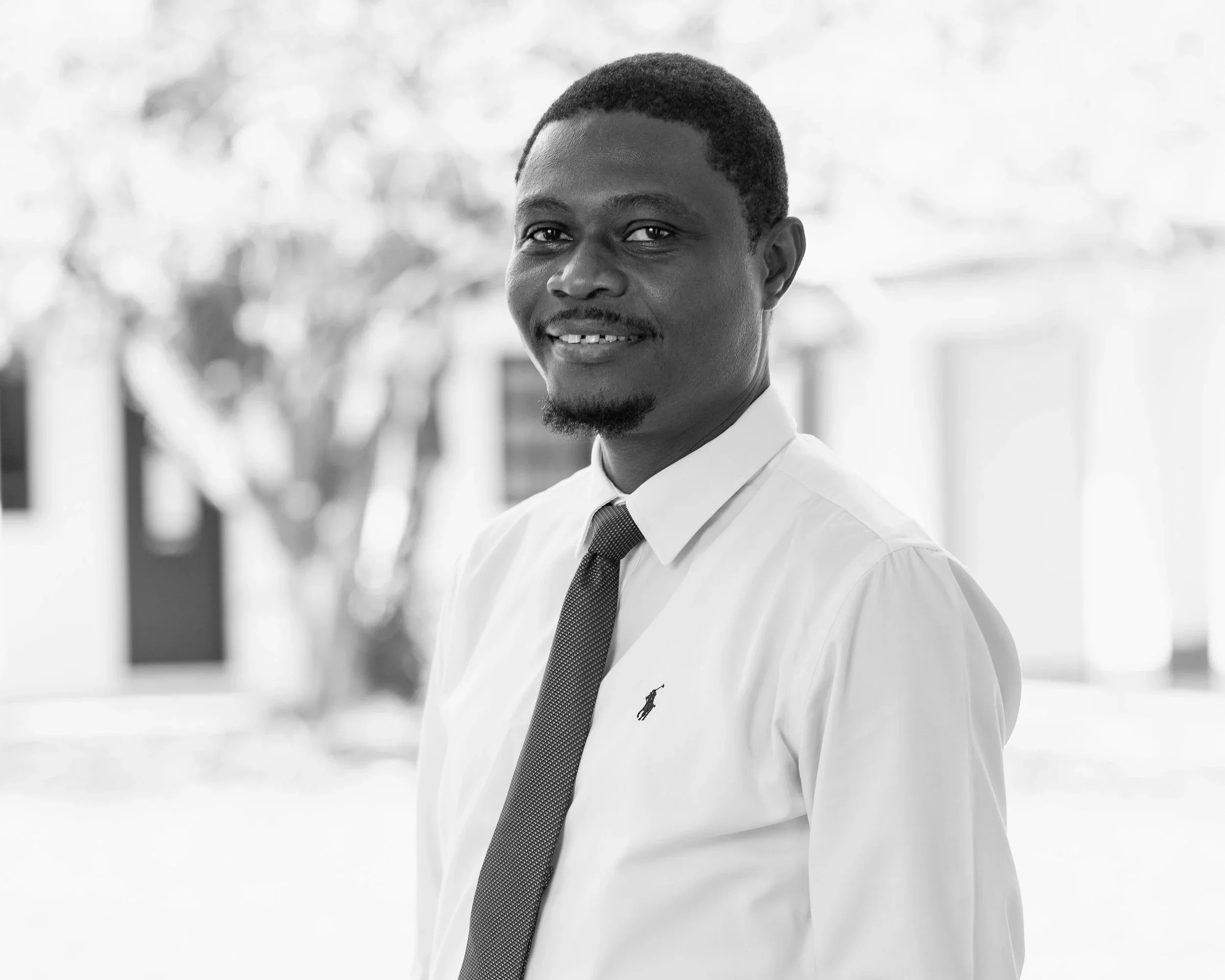
MARTIN EGBLEWOGBE is the author of the collection of short story collectionsies, The Waiting (Llubin & Kkleyner, 2020) and Mr Happy and The Hammer of God and other Stories (Ayebia, 2012). His writing has appeared in a number of collections, includingsuch as The Gonjon Pin (2014 Caine Prize anthology), PEN America’s Passages Africa (2015), All The Good Things Around Us (Ayebia, 2016), Litro #162: Literary Highlife (2017), Between The Generations (2020), Shimmering At Sunset (2021) and Voices That Sing Behind The Veil (2022). Martin was the commissioning editor for the anthology Resilience: A Collection (2021), and also co-edited the anthology of short stories, The Sea Has Drowned the Fish (2018) as well as the anthologies of poetry Look where you have gone to sit (Woeli, 2010) and According to Sources (Woeli, 2015). He is a co-founder and a director of the Writers Project of Ghana, and director of Pa Gya! A Literary Festival in Accra. He also hosts the radio show, Writers Project on Citi FM.