

Fringe Woman
Beah Batakou
Each day, a woman drags herself up
the headland, her gaze held to
the seam where light breaks water
waiting for the one the sea has already taken.
She would watch the rocks
hold the wild waves to breaking,
their bodies taking what they must
remembering the one the sea has already taken.
One night, she dreamed her body
had become the rock itself
and her lost love the ivy
still that once clung and climbed.
When I was eleven, in catechism class,
I learned to search for the mother of God
the way my A’maa did
on the algae-bloomed wall of the bathroom,
just beneath the showerhead,
after another long day
of the world’s quiet persecutions.
I embraced a world hostile to my survival.
Without complaint,
I kissed gods who loved without desire,
who desired without love.
My body has known the world
as the soul harbors sin.
I prayed the rosary once a day
and let the water scour me,
my face tilted northward
toward a sky with no sun.
My skin soon turned porcelain.
But while I was veiled from my own sight,
fire grew in my bones.
Radially knotted branches of light
shot out from my being,
like knotweed breaching concrete,
displacing parts of my otherness
and leaving obsidian
where there once was clay.
Thinking of Power as Fermented Fish
domineering in sizzling palm oil,
formidable in death.
Unlike their fellow citizens of the sea,
that fly and fall
Fins flexing back and forth,
flowing forward toward the moon
they, captives of fishermen,
are pried from ancestral memory:
flapping, flailing, failing,
gutted, salted, caged.
bodies broken and contained.
Yet, they live on
transmigrated into the palm of the executioner,
the tongue of the consumer,
the skin of the jailer.
ambassadors of retribution.
I must become as rude as momoni,
overshadowing the colonial red
which runs evenly across the sky.
I must become as offensive as kako,
hanging in the humid air
that sprawls over the country.
I must remain
a meteorological disturbance.
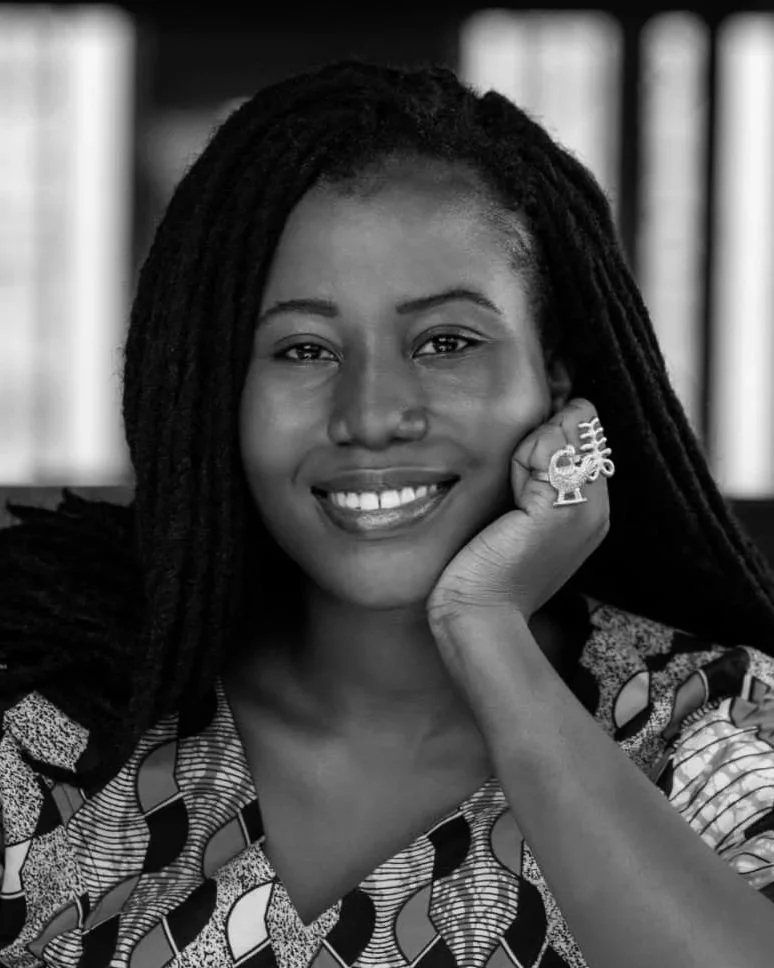
BEAH BATAKOU is a Ghanaian-Beninese poet whose work engages the body, memory, and belief as sites of inheritance and rupture. Drawing on Catholic liturgy, West African cosmologies, and lived domestic and institutional spaces, her poems reconfigure prayer, scripture, and ritual to examine loss, gendered violence, and survival. Her work has appeared in the Contemporary Ghanaian Writers Series, theWriter’s Project of Ghana Journal, and in regional and international publications including Lolwe and Libretto Magazine. She was a runner-up for the 2023 Adinkra Poetry Prize and completed a residency at the Watermill Center in New York in June 2025, where she developed a manuscript.